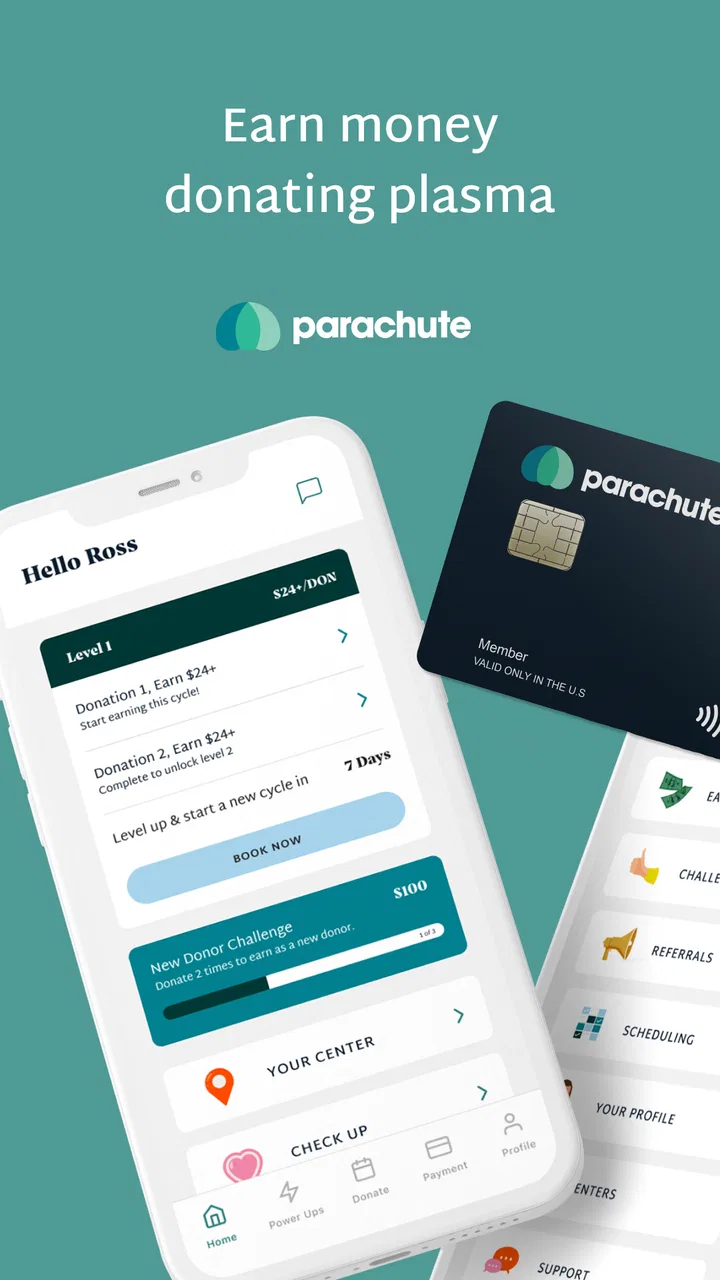
Parachute: Get Paid for Plasma
- 4.4
- Rating
- 100.00K
- Installs
- Free
- Price

 Analysis by App-foxy
I approached Parachute: Get Paid for Plasma with a practical question: does it remain useful after the first search for a donation center, or does it become an app I forget about? Its purpose is clear. This free medical-category app from Buoy Software, LLC helps people find verified plasma donation centers and manage the process of earning money through plasma donation. The idea is straightforward, but the real value depends on how often you donate, how much planning you need, and whether the app makes repeat visits easier than handling everything through separate websites or phone calls.
My first impression was that Parachute is aimed at a very specific need rather than trying to become a general health companion. It is not a symptom checker, a fitness tracker, or a broad medical reference. It focuses on the practical side of plasma donation: finding a suitable location and understanding the opportunity to receive compensation. That narrow focus is a strength because the app does not need to compete with unrelated health tools. It also creates a limitation: if you are only curious about plasma donation and do not intend to visit a center, there may be little reason to keep it installed.
How Parachute holds up beyond the first visit
I find the useful test for Parachute is whether it still helps once the initial search is over: can it support a change of routine, a new location, or a decision to pause? I’d use it as a way to revisit options, while keeping the center’s own guidance in charge of visit details and eligibility. That distinction leads to a closer look at how the app fits different needs and circumstances.
You May Also Like

 Blood Strike: 2.5 Anniversary
Blood Strike’s Loadouts Turn Every Drop Into a Tactical Gamble
A close look at Blood Strike’s custom loadouts: how fast access to signature weapons reshapes its battle royale rhythm, rewards preparation, and narrows the gap between fights.

 Pandora - Music & Podcasts
Pandora’s Music Is Easy to Start, but Harder to Recover
Pandora’s strength is its low-effort path from a seed to a station. Its weak spot is how much confidence it asks you to place in connection, setup, and quiet recovery.

 8 Ball Pool
 Is Built on Rivalries, Rematches, and Routine
A close look at the rivalries, rematches, shared routines, and unanswered safety questions that turn a quick pool match into a persistent mobile community.

 Samsung Music
’s Quiet Strength Is Playing What You Already Own
Its reach comes less from spectacle than from dependable access to a personal library. That simplicity is both the app’s strongest retention engine and its ceiling.

 AccuWeather: Weather Radar
AccuWeather Review: A Quick, Clear Forecast for Everyday Decisions
For everyday plans, the best forecast is the one you can understand quickly. AccuWeather makes rain timing, radar, and local conditions easy to act on, with a few trade-offs.

 Hill Climb Racing
Why Hill Climb Racing Still Turns Crashes Into One More Run
A tiny car, a bumpy hill and one more upgrade: Hill Climb Racing keeps resurfacing because its simple chaos makes every near-miss feel personal.
More From Our News Desk



The first-week appeal comes from turning curiosity into a plan
The strongest part of the experience is the way the app gives a concrete direction to someone who has been wondering whether plasma donation could fit into their routine. Searching online can quickly become confusing. Different centers may have different locations, requirements, schedules, and compensation information, while general search results mix official pages with advertisements and outdated discussions. Parachute’s focus on verified centers gives the initial research a more useful starting point.
I found the app most appealing for someone who has already decided to investigate donation but has not yet chosen where to go. Instead of treating the process as an abstract way to make extra money, it frames it around actual centers. That matters because the nearest location is not always the best choice. A center that looks attractive financially may be inconvenient to reach, while a slightly farther location might fit better with work, school, or public transportation. The app is most helpful when used as the beginning of a comparison rather than as a promise that every option will suit every person.
The compensation angle is naturally attention-grabbing. Parachute presents the possibility of earning up to 200 dollars in three visits, which can make the first step feel more tangible. I would treat that figure as an incentive to investigate, not as money to build a budget around. Donation compensation can depend on the center’s own terms and the person’s eligibility, so the sensible workflow is to use Parachute to locate an option, then read the center’s current instructions carefully before making travel plans.
That distinction is important for first-time donors. An app can help you find a place, but it cannot replace the center’s screening process or guarantee that you will be accepted on a particular day. I would prepare by checking identification requirements, opening hours, appointment expectations, and health-related eligibility details directly with the selected center. This small amount of preparation prevents the most frustrating first-use scenario: traveling across town and discovering that a document, appointment, or condition prevents donation.
Another useful first-week habit is to compare the total effort, not just the advertised payment. I would consider travel time, parking or transit costs, waiting, the possibility of returning for future visits, and whether the location is near a regular route. The app helps surface the donation opportunity, but the user still has to make the practical calculation. A center that is easy to reach repeatedly may be more valuable than one that looks better in a quick search.
What makes the app different from ordinary web searching
The usual alternative is to search the web for plasma centers, open several pages, and keep notes manually. That approach can work, especially for someone who prefers a desktop browser or already knows a nearby provider. Parachute is more convenient for people who want a focused mobile starting point. Its identity is built around connecting the user with verified centers rather than making the user assemble a list from scattered results.
That does not mean it replaces every alternative. A center’s own website or phone line remains the better source for final confirmation, particularly when details affect whether a visit will be worthwhile. Parachute works best as a discovery and planning layer. I would not use it as the only authority for medical eligibility, current center procedures, or anything that could change between visits.
The app’s mature age rating also sets the right expectation. Plasma donation and compensation are adult subjects involving health screening and personal responsibility. This is not a casual rewards app for younger users, and I would not recommend treating it like one. Anyone considering donation should be comfortable reviewing health requirements and making an informed decision rather than focusing only on the payment.
Month-to-month value depends on repeat donations
Parachute’s lasting value is tied to behavior. If you donate once and have no intention of returning, the app may serve its purpose quickly and then become unnecessary. For a regular donor, however, the ability to keep a donation center in mind and revisit the search process can make it more useful over time. The app has a better chance of earning permanent space on a phone when it supports an ongoing routine rather than a one-time curiosity.
A realistic example would be someone whose work schedule changes from week to week. During the first month, that person might use Parachute to identify a verified center near home. Later, a different center may be more convenient after a shift change or move. Instead of assuming the original choice remains ideal, the user can return to the app and reassess location options. That is a modest benefit, but it is the kind that can matter more than a flashy first impression.
I also see value for people who are comparing donation with other ways of earning occasional extra money. The app can help turn a vague idea into a specific logistical question: is there a center close enough, and can the visits fit into real life? That is more useful than simply seeing a compensation claim. The decision should include time, travel, comfort, health, and consistency. Parachute supports the research stage, while the user decides whether the routine is personally worthwhile.
For repeat use, I would keep my own simple notes outside the app: the center I visited, the date, travel time, questions to ask next time, and any information the center gave me. I would not assume that the app itself is a complete personal donation diary unless the current experience clearly provides that function. This is one of the most practical trade-offs: Parachute can help with finding opportunities, but a small personal record may still be needed for planning.
Its audience size suggests that the concept has reached beyond a tiny niche. Parachute has more than 100 thousand installs and an average rating of 4.4 from around 1.3 thousand ratings. Those figures indicate a generally positive reception, but they do not remove the need to judge the app against your own situation. A person living far from a verified center will experience less value than someone with several realistic options nearby.
The maintenance burden is low, but the real work happens outside the app
One reason I can imagine keeping Parachute installed is that it does not ask to become a daily habit. This is not an app I would expect to open every morning. Its maintenance burden is more occasional: revisit it when planning a donation, check whether another center is more convenient, and confirm current details before traveling. That light-touch pattern is appropriate for the subject.
At the same time, the app cannot remove the maintenance required by plasma donation itself. The user must still monitor personal availability, follow the center’s instructions, protect time for the visit, and pay attention to how they feel. The application may make discovery easier, but it does not turn donation into a completely passive income stream. Anyone expecting an automated earnings tracker or a hands-off process may find the experience less convenient than imagined.
I would also avoid relying on old information saved in memory. Center schedules, visit procedures, and compensation arrangements can change. Even if Parachute helps identify a verified location, I would confirm the important details immediately before going. This is not a criticism unique to the app; it is a necessary habit whenever a mobile tool points users toward a real-world medical service.
The current version is listed as 120260727, and the app supports Android 7.0 or later. That broad compatibility is helpful for people using older Android phones, although compatibility alone does not guarantee that every device will feel equally smooth. I would still keep the operating system updated where possible and make sure the phone has enough battery and connectivity when using the app while traveling.
Because the app is free, the decision to try it carries little financial risk. The more meaningful cost is attention: learning the app, checking a center, and deciding whether the resulting option fits your schedule. Free access makes it easy to test, but it should not encourage rushed donation decisions. The health and time commitments deserve more consideration than the download itself.
Where fatigue can appear after the novelty fades
The first source of fatigue is repetition. If you already know the center you use and its process never changes, opening a discovery-focused app before every visit may feel unnecessary. In that case, the center’s own communication channels may become faster. Parachute is more valuable when you are still comparing options, moving, changing schedules, or trying to understand where donation is available.
The second source is the gap between finding a center and completing a visit. Users may hope that a location search immediately answers every practical question, but real-world donation involves screening and center-specific instructions. If you open the app expecting a guaranteed appointment, guaranteed acceptance, or guaranteed payment, disappointment is likely. The app should be treated as a planning aid, not a substitute for the center’s staff or medical judgment.
A third issue is emotional fatigue. Compensation can make donation feel like a simple transaction, but it still involves a personal health decision and a physical commitment. I would be cautious about using the app as a reason to donate when I was tired, unwell, or under financial pressure. The most responsible use is to let the app help with logistics while keeping the health decision separate from the financial temptation.
There is also a comparison problem. Parachute may be more focused than a general search engine, but a focused tool can show only what is relevant to its own purpose. If you want broad information about donation safety, personal eligibility, or medical questions, I would look to qualified healthcare guidance and the donation center itself rather than expecting this app to answer everything. That division of labor makes the experience safer and more realistic.
For someone who dislikes maintaining several apps, the question is simple: does Parachute save enough time to justify staying installed? My answer is yes if you are actively looking for verified plasma centers or expect your preferred location to change. My answer is probably no if you have already settled into a reliable center and rarely need to search. The app’s recurring value is situational, not universal.
Who should use it, and who should choose another route
I would recommend Parachute to an adult who is seriously exploring plasma donation, wants a mobile-first way to find verified centers, and is willing to confirm details before visiting. It is particularly suitable for people who are new to the process, comparing locations, or trying to fit donation around a changing routine. Its narrow purpose makes it easier to understand than a large health platform filled with unrelated tools.
I would be more cautious recommending it to someone who wants a complete medical education resource, a detailed personal health record, or a guaranteed earnings planner. It is also not the right choice for anyone who would make a donation decision based solely on the compensation headline. In those situations, a healthcare professional, an official center, or a broader personal budgeting tool would be a better companion.
My preferred workflow is to use Parachute for the first search, shortlist a convenient verified center, check the center’s own current requirements, and then decide whether the visit fits my health and schedule. After that, I would keep a small personal record and return to the app only when I need to compare locations or reconsider my routine. This avoids both extremes: ignoring a useful discovery tool and depending on it for decisions it was not designed to make.
My long-term verdict
Parachute earns lasting space only for the right kind of user, but it can earn that space honestly. Its strongest quality is focus: it connects the idea of compensated plasma donation with the practical task of locating verified centers. That is more useful than a generic health app when the user’s goal is specific and immediate.
In my experience, the app’s first-week appeal is stronger than its everyday appeal, and that is not necessarily a flaw. This is a tool for occasional planning, not constant engagement. After the novelty fades, its value comes from returning when circumstances change: a new neighborhood, a different work schedule, a need to compare centers, or renewed interest in donation.
The main trade-off is that Parachute simplifies discovery but does not eliminate responsibility. You still need to confirm center details, understand eligibility, plan travel, and decide whether donation is appropriate for you. If you accept that boundary, the app is a sensible free starting point. If you want an all-in-one medical or financial assistant, it will feel too narrow.
With a 4.4 average and over 600 written reviews, it has a credible base of user feedback, while its mature rating accurately reflects the seriousness of the subject. I would install it when actively researching plasma donation, use it deliberately rather than compulsively, and keep it only if it continues to save time during repeat planning. Its lasting value is practical, not addictive: it stays useful when it reduces real-world friction.
FAQs for Parachute: Get Paid for Plasma
01What is Parachute: Get Paid for Plasma?
Parachute: Get Paid for Plasma is an app designed to help users find and connect with plasma donation opportunities. It may provide information about participating donation centers, eligibility requirements, appointment details, and potential compensation. The app itself does not replace a medical screening, and users must complete the donation center’s approval process before donating or receiving payment.
02How does Parachute help users get paid for plasma donations?
The app can help users discover participating plasma centers and understand the steps involved in making a donation. Compensation is generally determined by the individual donation center, location, current promotions, and the donor’s eligibility. Parachute should not be treated as a guarantee of a specific payment amount, since final compensation and payment timing are controlled by the plasma provider.
03Who can use Parachute and donate plasma?
Parachute may be available to adults who meet the requirements established by participating plasma donation centers. Common requirements can include age, minimum weight, valid identification, proof of address, health history, and acceptable medical screening results. Rules vary by location, and downloading the app does not mean that every user will automatically qualify to donate or receive compensation.
04Is Parachute safe to use, and what about plasma donation itself?
Using the app to review donation information or locate a center is generally separate from the medical procedure. Plasma donation should only be completed at a licensed and approved facility with trained staff. Before donating, users should carefully review the center’s privacy policy, health requirements, possible side effects, and consent information. Anyone with medical concerns should consult a healthcare professional first.
05Does Parachute cost money, and what information does it require?
The app may be free to download, although users should check its current store listing for any changes, optional services, or regional restrictions. Depending on its features, Parachute may request information such as location, contact details, identification-related data, or donation preferences. Before creating an account, review the requested permissions and privacy policy to understand how personal information is collected, used, and shared.
Pros
- Earn extra money by donating plasma at participating centers.
- The app helps locate nearby plasma donation facilities.
- Appointment scheduling can make visits more convenient.
- Payment details and donation history are easy to track.
- Useful reminders may help users stay consistent with appointments.
Cons
- Availability depends heavily on your location and nearby partner centers.
- You must meet strict health and eligibility requirements to donate.
- Payments and rewards may vary by center and promotional offers.
- The app cannot guarantee short wait times at donation facilities.
- Frequent donations can be tiring and may cause temporary discomfort.

Parachute: Get Paid for Plasma
Gallery